
The emerging smart home landscape for 2025 is dominated by deeper integration of Artificial Intelligence (AI) across almost all device categories, focusing on personalization, predictive automation, enhanced security, and wellness.
Here are the key areas for new and innovative smart home devices expected in 2025 and beyond:
1. AI-Powered Personalization and Automation

The next generation of smart devices moves beyond simple automation to become truly predictive and proactive.
- Advanced AI Home Assistants: Voice assistants like Google Assistant (with Gemini integration) and Alexa are becoming smarter, acting as an “active orchestrator” for your home. They will learn your habits to a granular degree, anticipating needs and making system-wide decisions to optimize comfort and efficiency without you asking.
- Routine-Based Personalization: Systems will automatically adjust lighting, climate, entertainment, and security settings based on your daily patterns, seasonal changes, and even your emotional state (Emotional AI).
- Agentic AI: Autonomous, action-taking AI that can handle complex day-to-day tasks like ordering groceries or managing household logistics through your smart home devices.
2. Enhanced Security and Privacy

Security systems are getting significantly more intelligent and localized for faster response and improved privacy.
- Intelligent Security Systems: AI-powered security cameras will use complex computer vision to differentiate between family, pets, vehicles, and potential intruders with high accuracy, drastically reducing false alarms.
- Predictive Threat Assessment: Systems will go beyond detection to actively look for and react to possible threats, such as recognizing suspicious vehicles in the neighborhood or tracking abnormal movement patterns.
- Edge Computing: More devices will process sensitive data (like facial recognition video) locally on an on-site hub or the device itself, rather than in the cloud. This increases privacy and speeds up response times, which is critical for security devices like smart locks and alarms.
- Next-Gen Access: New biometric security, such as the Philips Wi-Fi Palm Recognition Smart Deadbolt, offers keyless entry using unique body features.
- Integrated Video Doorbells: These are moving from standalone gadgets to fully integrated systems that plug into the whole home’s security, allowing them to remotely control smart locks and exterior lighting based on activity.
3. Wellness and Health Monitoring

The smart home is becoming a personal wellness center through advanced non-contact sensors.
- Biometric Integration: Smart home devices and wearables (like smart earbuds) will continuously and non-invasively monitor health metrics like heart rate variability, sleep patterns, respiratory rates, and stress hormones.
- Predictive Health Features: AI systems will analyze these biometrics and behavioral patterns (like changes in gait) to predict potential health issues days or weeks before symptoms appear, and can automatically alert caregivers or emergency services in case of a detected fall or medical emergency.
- Smart Bathroom Tech: Expect integrated smart showers with voice-activated and customizable temperature/pressure settings, smart toilets with heated seats and bidet features, and smart mirrors that offer defogging, lighting, weather updates, and home assistant access.
- Advanced Air Quality Tracking: Multi-sensor systems are tracking more indoor pollutants in real-time, including carbon dioxide, VOCs, and particulate matter, often coupled with smart mechanical ventilation to actively improve air quality.
4. Smart Appliances and Kitchen Tech
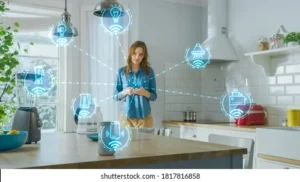
Appliances are getting smarter with generative AI for better management and a more seamless look.
- AI-Enhanced Kitchens: Smart refrigerators from companies like Samsung and LG will utilize interior cameras and generative AI to proactively catalog and track the items inside, helping with meal planning and grocery ordering.
- Invisible Cooktops: Technologies like hidden induction cooktops will transform countertops into multi-purpose surfaces for food prep and cooking, creating a futuristic, minimalist kitchen design.
- Smart Ovens: New smart ovens will support voice-controlled preheating, food monitoring, and maintenance alerts via integrated Wi-Fi.
5. Seamless Connectivity and Efficiency
The foundation of the smart home is getting stronger and more efficient.
- Universal Interoperability: Continued growth of connectivity standards like Matter and Thread will enable smart devices from different brands to communicate and work together more seamlessly than ever before.
- Sustainable Energy Management: Advanced systems will integrate solar panels, battery storage (like Tesla’s Powerwall), and smart load-shifting technologies to continuously monitor and optimize your home’s energy use, prioritizing renewable sources and reducing energy costs.
- Wireless Power Sensors: Battery-free smart home automation sensors that are perpetually powered wirelessly from a nearby RF transmitter, eliminating the need for batteries or wiring for devices like window, door, and temperature sensors.